 Tower Rush
Tower Rush RTP and odds, measured
 Zeeshan MirzaInstant games analyst
Tower Rush publishes one number: an RTP between 95.46% and 98.5%. It does not publish the chance of a collapse, the odds distribution of the floors, or how often a bonus floor appears. So we measured them.
For this page a script played rounds on Galaxsys' own Tower Rush demo server, pressed Build until each tower fell, and stored every reply the server sent back. Nothing below is modelled or estimated from videos: each figure is a count of what the server actually did.
Tower Rush,
on your phone.
The same Galaxsys game in portrait mode: Build and Cashout under your thumb, the three bonus floors, PKR balance and JazzCash or Easypaisa at the cashier.
Get the app Download from the operator, not from a file-sharing link. 18+ only. Gambling can be addictive.
The declared RTP: 95.46% to 98.5%
The Rules panel inside the game says: RTP of the game is 95.46%–98.5%. That range exists because Galaxsys sells the game in several configurations and each casino chooses one.
What the range means in rupees, over a very long run of play:
| RTP | House keeps per Rs 100 staked | Per Rs 10,000 staked |
|---|---|---|
| 98.5% | Rs 1.50 | Rs 150 |
| 97% | Rs 3.00 | Rs 300 |
| 95.46% | Rs 4.54 | Rs 454 |
Two things follow. First, the same game can cost three times more at one casino than at another, and most casinos do not display which configuration they run. Second, the RTP describes the average across millions of rounds. Over one evening, your result is dominated by variance, not by the RTP.
If a casino shows a game information panel with the RTP, read it. If it does not, assume the lower end.
How we measured the game
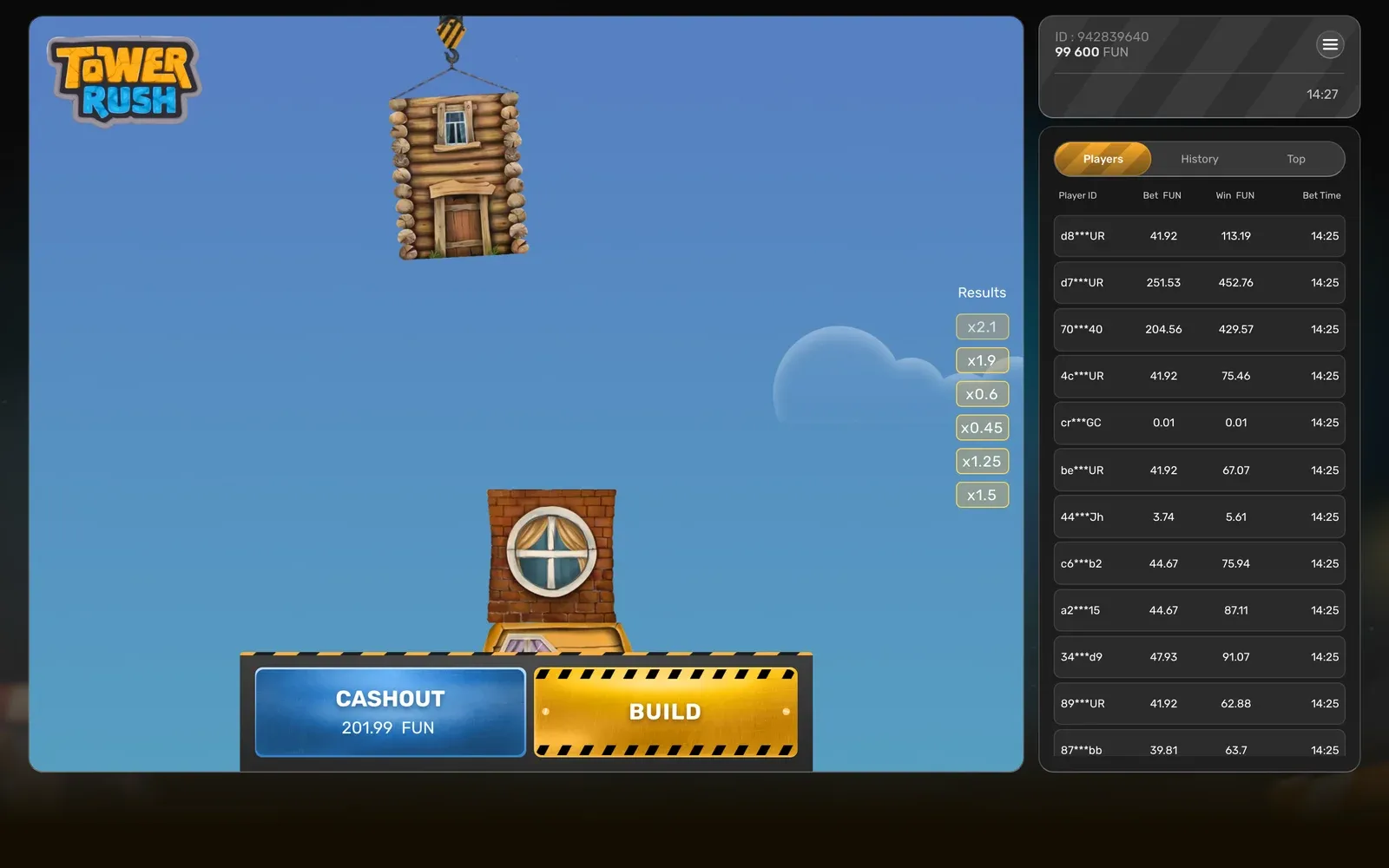
The official demo client talks to a game server over a live connection. When you press Build, the client sends a request; the server replies with the floor that landed: its odds, its visual type, whether it was a bonus floor, whether the round is finished, and the running win.
Our script sent the same requests the demo client sends, one at a time, with a small pause between them:
- every round started with the minimum stake;
- every round was built until it collapsed (or reached 40 floors, which never mattered for the averages);
- every server reply was saved untouched.
Because each tower was played to the end, one sample answers many questions at once. "What if I always cash out after three presses?" is simply every round, stopped at press three.
Limits of the method are covered below. The raw log and both scripts are kept with the project, so the numbers can be re-run and checked.
The measured numbers
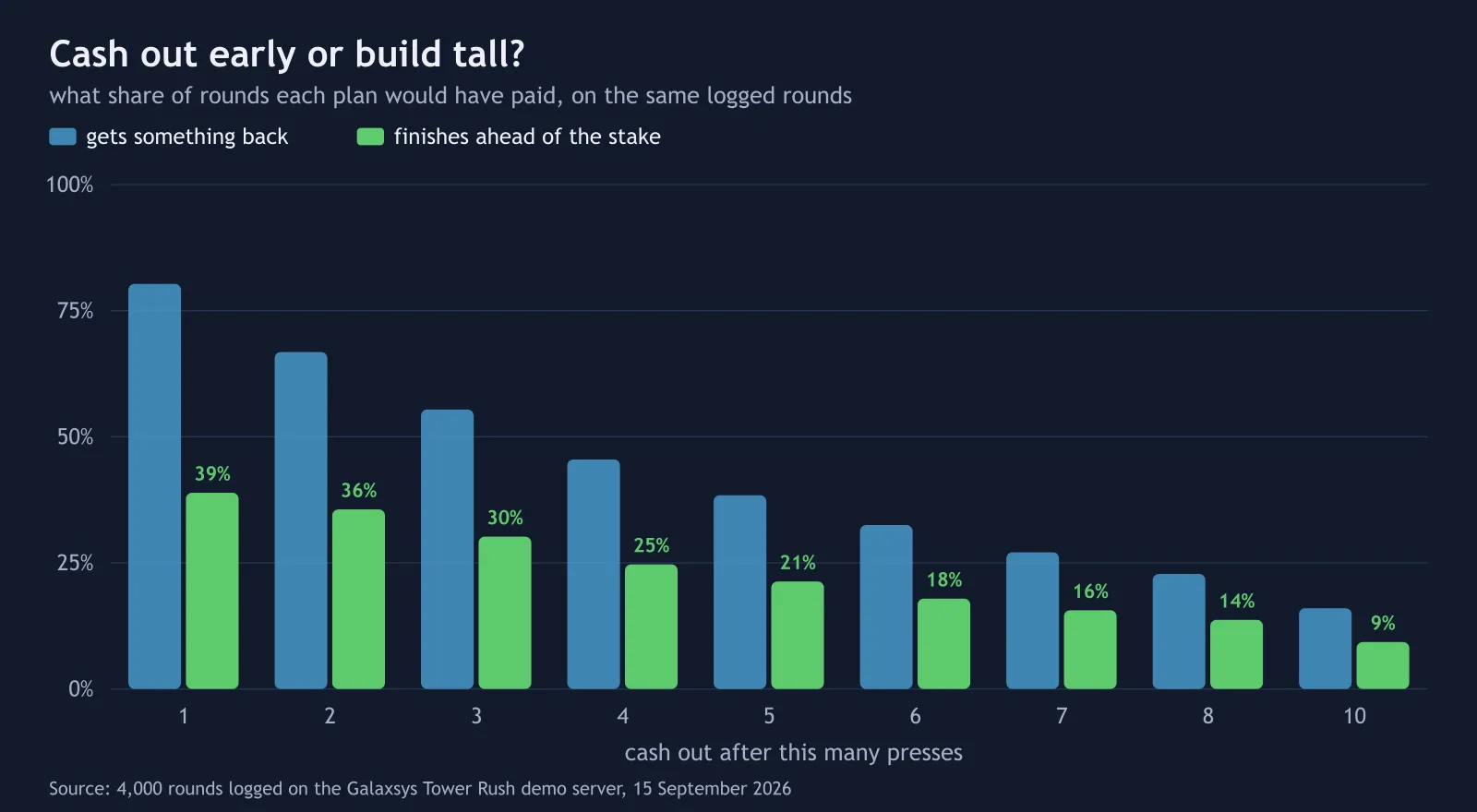
The table below updates from our log. The first tab answers the question most players care about: if I always cash out after N presses, how often do I finish ahead?
4,000 rounds, 23,036 presses of Build, played on the Galaxsys demo server and logged straight from its replies. Sample collected 15 September 2026.
| Cash out after | Finish ahead | Get anything back | Median result | Measured return |
|---|---|---|---|---|
| 1 press | 80.3% | x1.00 | 99.8% ± 3.1 | |
| 2 presses | 66.8% | x0.63 | 100.8% ± 5.0 | |
| 3 presses | 55.4% | x0.33 | 106.1% ± 9.2 | |
| 4 presses | 45.5% | x0.00 | 100.6% ± 9.1 | |
| 5 presses | 38.4% | x0.00 | 103.9% ± 12.1 | |
| 6 presses | 32.5% | x0.00 | 96.6% ± 12.8 | |
| 7 presses | 27.1% | x0.00 | 95.0% ± 18.5 | |
| 8 presses | 22.8% | x0.00 | 91.3% ± 20.7 | |
| 10 presses | 16.0% | x0.00 | 94.9% ± 33.9 | |
| 12 presses | 11.0% | x0.00 | 72.1% ± 32.5 | |
| 15 presses | 7.1% | x0.00 | 86.6% ± 63.4 |
| Press | Rounds that got here | Collapsed on this press |
|---|---|---|
| 1 | 4,000 | |
| 2 | 3,210 | |
| 3 | 2,671 | |
| 4 | 2,210 | |
| 5 | 1,813 | |
| 6 | 1,523 | |
| 7 | 1,286 | |
| 8 | 1,067 | |
| 9 | 888 | |
| 10 | 736 | |
| 11 | 614 | |
| 12 | 489 |
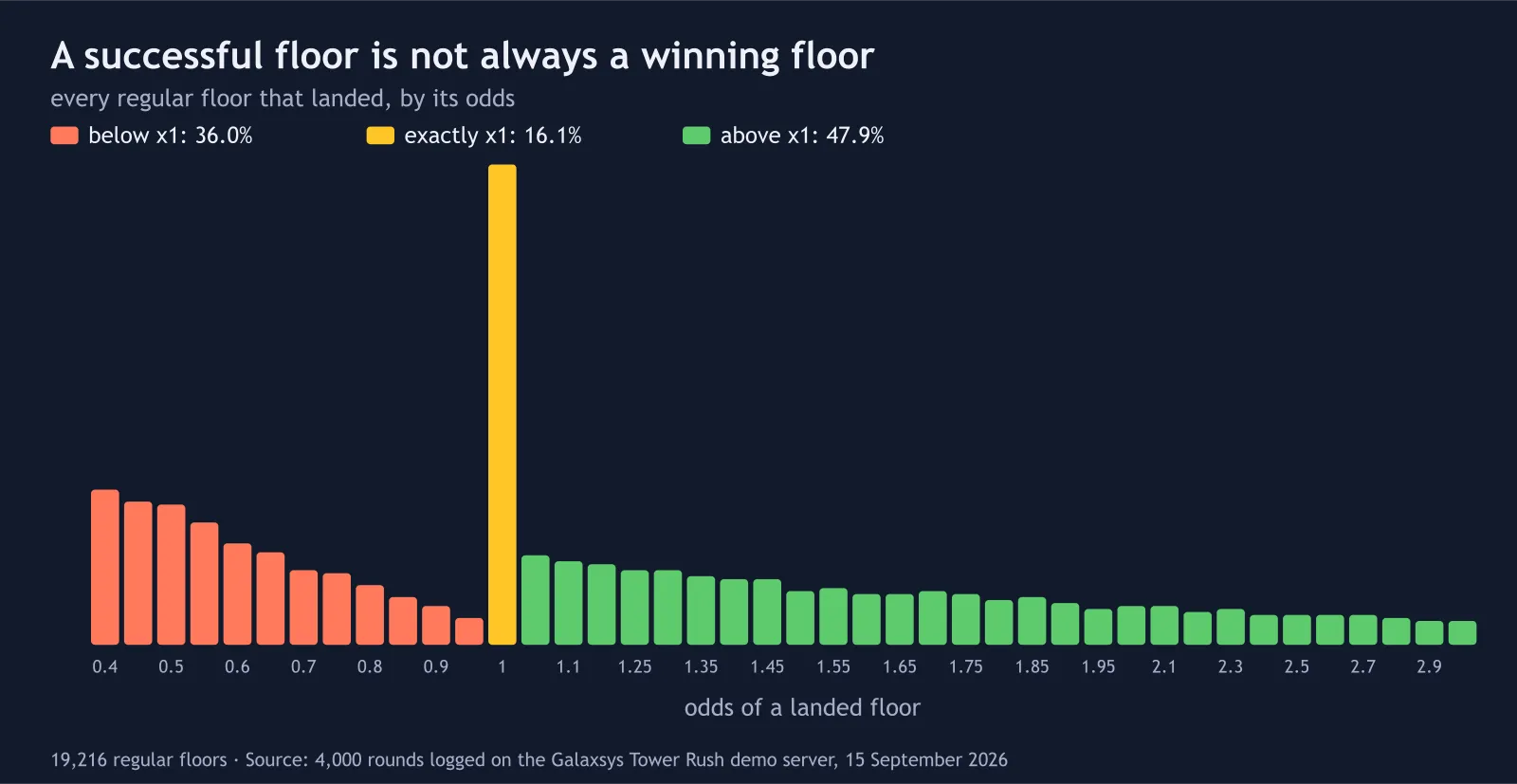
Of 19,216 floors that landed: 36.0% shrank the win (below x1), 16.1% left it unchanged (x1) and 47.9% grew it. Average odds x1.183, geometric average x1.032.
Measured return is total paid ÷ total staked on the logged rounds, with a 95% margin. A few very tall towers dominate it for long plans; the hit rates and medians are the stable columns.
How to read the columns:
- Finish ahead — the round paid more than the stake.
- Get anything back — the round paid something, even if less than the stake (a tower cashed out at x0.7 pays back 70%).
- Median result — half the rounds paid less than this. From about four presses the median is zero: most rounds of that length collapse.
- Measured return — total paid ÷ total staked, with a 95% margin. Read the margin before the number: a handful of very tall towers moves it a lot.
Collapse risk per press
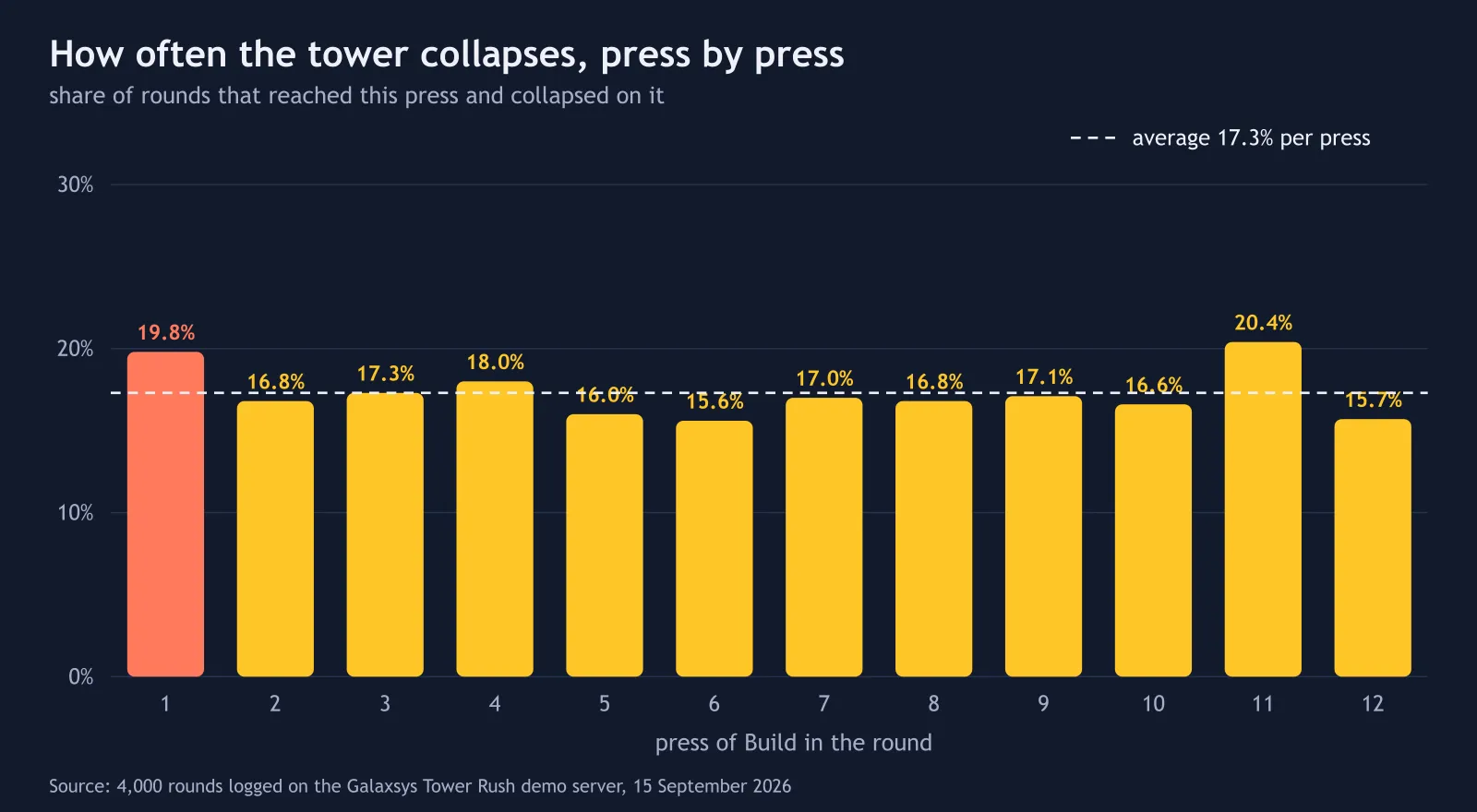
About one press in six ends the round. The first press is the exception, collapsing about one time in five, which means a real share of rounds end before you ever see the Cashout button.
After the first press the rate does not climb as the tower grows. That has two consequences worth writing down:
- Tall towers are not riskier per press. The fifteenth press is about as dangerous as the third.
- Tall towers are rare anyway, because surviving fifteen presses in a row at five-in-six each is roughly a one-in-fifteen shot, before even asking whether the floors grew the win.
And it rules out a popular myth: a tower that has survived ten floors is not "due" to collapse, and one that just collapsed twice is not "due" to survive.
Floor odds: why the average misleads
Regular floors landed at odds from x0.4 to x3, in steps of 0.05 up to x2 and steps of 0.1 above it.
- About 36% of floors were below x1 and shrank the win.
- About 16% were exactly x1 and changed nothing.
- About 48% were above x1.
The simple average floor is about x1.18. That sounds generous. But floors multiply, and for multiplication the fair average is the geometric one, which is only about x1.03. In practice: a tower of five "average" floors is worth about x1.17, not the x2.3 that the simple average suggests.
That gap is the reason towers that look busy on screen so often cash out for little more than the stake.
How often bonus floors land
| Bonus floor | Roughly how often |
|---|---|
| Triple Build | under 1 per 100 presses |
| Temple Floor (wheel) | about 1 per 250 presses |
| Frozen Floor | about 1 per 700 presses |
The Temple wheel's results in our log matched its published sections: x1.5, x2, x3, x5 and x7 all appeared. Because bonus floors are this rare and indistinguishable before they land, no stake plan can target them.

What the sample cannot tell you
Honesty about the method matters more than the decimals:
- It is the demo configuration. The demo runs one RTP setting. A casino may run a different one inside the 95.46%–98.5% range.
- Heavy tail. A few towers climbed past x1,000. Such rounds decide the measured return for long strategies, which is why its margin grows so fast. Hit rates and medians are the reliable columns.
- No prediction. The log shows how the game behaves on average. It says nothing about your next press.
RTP compared with other crash games
| Game | Provider | Declared RTP |
|---|---|---|
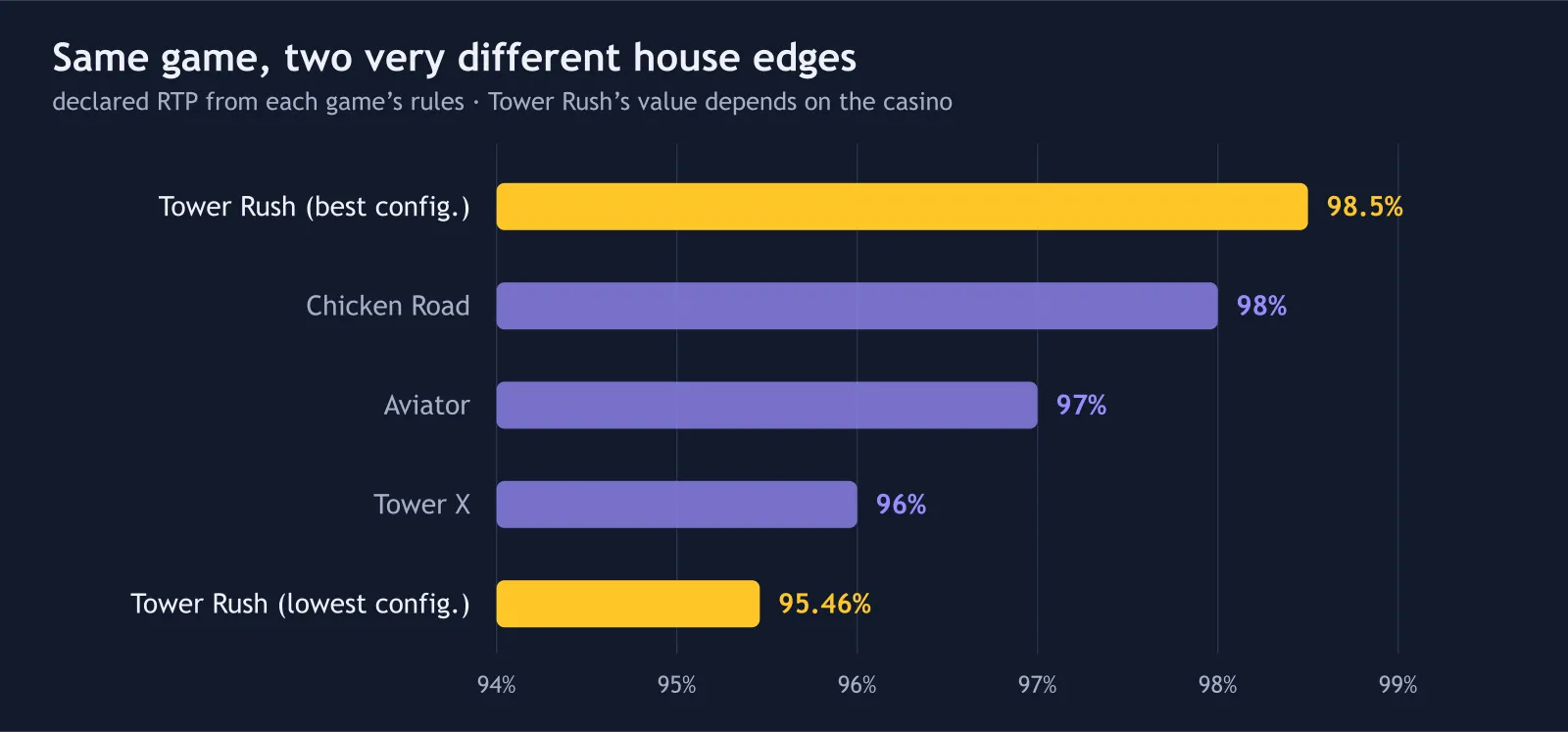
| Tower Rush | Galaxsys | 95.46%–98.5% |
| Chicken Road | InOut Games | 98% |
| Aviator | Spribe | 97% |
| Tower X | SmartSoft Gaming | 96% |
At its best configuration Tower Rush is among the most generous crash games; at its worst it sits below Aviator. The game does not tell you which one you are playing. The casino's info panel might.
FAQ about Tower Rush RTP and odds
What is Tower Rush's RTP?
The game's rules state 95.46%–98.5%. The casino selects the configuration, so the exact figure depends on where you play. The house edge is therefore between 1.5% and 4.54%.
What are the chances of a collapse in Tower Rush?
In our log of demo-server rounds, about one press in six collapsed the tower. The first press was riskier, at about one in five, and later presses stayed roughly flat.
Is the Tower Rush demo RTP the same as real money?
The demo runs one fixed configuration. Real-money casinos choose theirs between 95.46% and 98.5%. The floors, bonus floors and rules are identical.
Why does my tower grow so slowly?
Because about a third of floors land below x1 and the odds multiply. The geometric average floor in our log was only about x1.03, so a five-floor tower is typically worth around x1.2.
How rare are bonus floors in Tower Rush?
Rare. Triple Build appeared under once per hundred presses in our log, the Temple wheel about two-thirds as often and the Frozen Floor far less often.
Can you calculate the next floor in Tower Rush?
No. The next floor's odds and whether it collapses are decided by the game server when you press Build. Our statistics describe the average behaviour of the game, not the next result.
You have the numbers. The rest is a choice.
No cash-out point beats the house; each one only changes the shape of a session. Test it in the demo with free credit before deciding anything else.